DevOps & CI/CD
· 4 min read
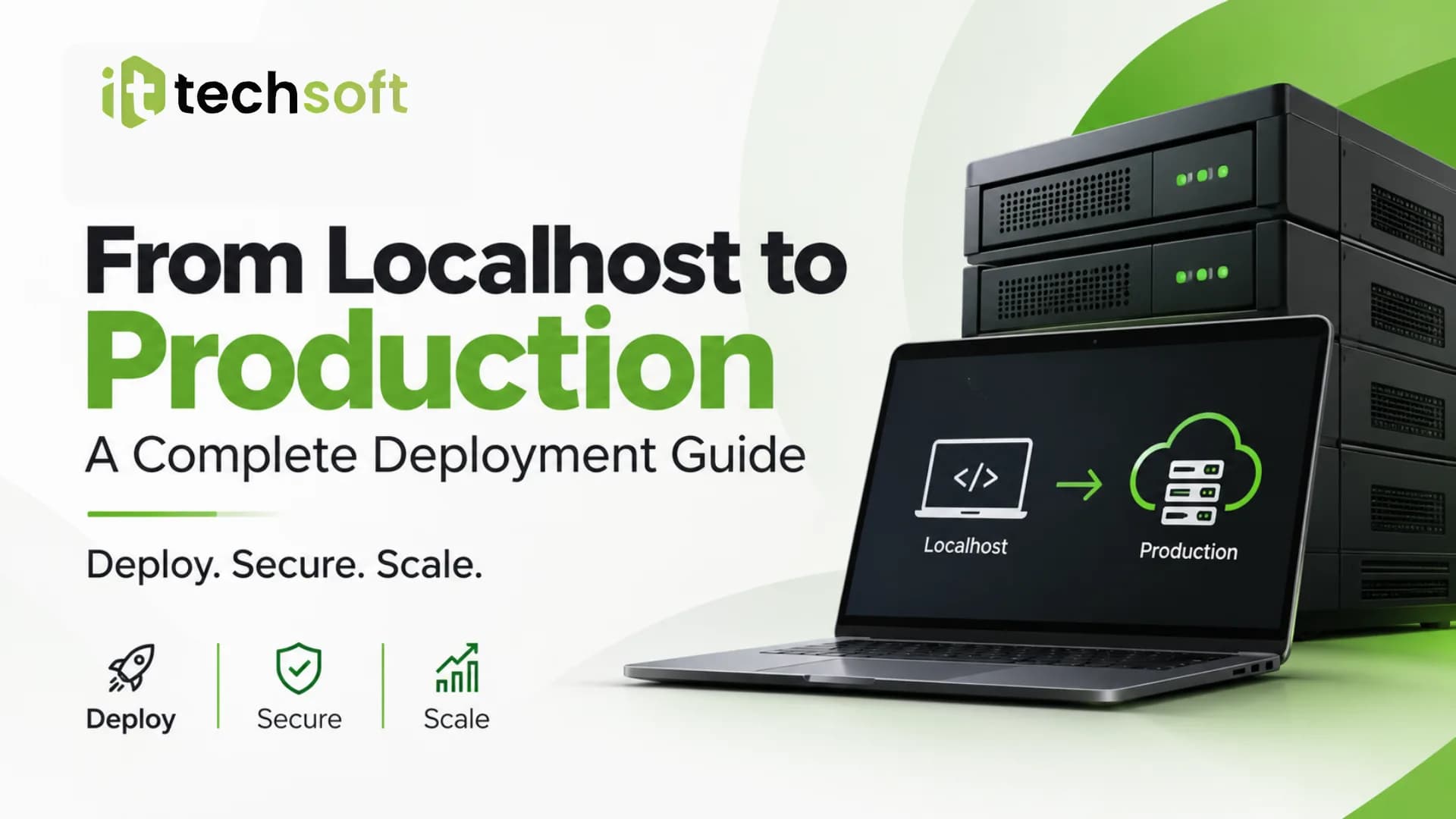
From Localhost to Production: A Complete Deployment Guide
Learn how to move your app from localhost to production with secure VPS setup, Nginx, SSL, CI/CD, monitoring, backups and performance optimization.
· 4 min read
Learn how to move your app from localhost to production with secure VPS setup, Nginx, SSL, CI/CD, monitoring, backups and performance optimization.

· 6 min read
Learn how to secure an Ubuntu VPS in 2026 with SSH hardening, UFW firewall, automatic updates, SSL/TLS, backups, and server monitoring.
Building an application is only the first step. Making it reliable, secure, and ready for real users is an entirely different challenge.
Your application might work perfectly on localhost, but production introduces new responsibilities. Server configuration, environment variables, SSL certificates, deployment automation, security, monitoring, and database performance all become critical.
For startups, SaaS founders, AI builders, and development agencies, getting these things right from the beginning can prevent unnecessary downtime, security issues, and expensive technical problems.
In this guide, we'll explain what your application needs before going live.
Your production environment needs to be properly configured before deploying your application.
Depending on your application and expected traffic, you might use a Linux VPS or a cloud infrastructure provider.
Important setup requirements include:
For Next.js applications, the official Next.js deployment documentation explains the available deployment approaches.
A properly configured server provides a stable foundation for your application.
Need help setting up your application? Explore our Next.js and production deployment services.
Your application should be accessible through a properly configured domain with HTTPS enabled.
SSL/TLS encryption protects data transmitted between users and your application.
Before launching, verify:
You can use Nginx documentation to understand reverse proxy configuration and Certbot to configure SSL certificates.
These steps help establish a secure and professional production environment.
Manually connecting to a server and deploying every update can become unreliable as your application grows.
A CI/CD pipeline helps automate the process of building, testing, and deploying application updates.
Tools such as GitHub Actions can help you:
For applications that require high availability, deployment strategies should also consider health checks, rollback procedures, and zero-downtime release techniques.
Learn more from the official GitHub Actions documentation.
A working application is not necessarily a secure application.
Production infrastructure needs ongoing security attention.
Some essential practices include:
Security is not a one-time configuration. It requires regular reviews and maintenance.
For a more secure production environment, explore our server security and hardening services.
You can also review the official Ubuntu security documentation.
Problems can happen even when an application is configured correctly.
Monitoring helps identify infrastructure and application issues before they become larger problems.
Your production environment should have:
Remember: A backup is only useful when you can successfully restore it.
A proper backup strategy should include recovery procedures, retention policies, and regular restoration testing.
As more users interact with your application, performance problems can become noticeable.
Slow database queries, inefficient caching, and connection pool exhaustion can affect the user experience.
Consider reviewing:
For PostgreSQL applications, the official EXPLAIN documentation provides useful information about understanding query execution plans.
Performance optimization should be based on measurements rather than assumptions.
Explore our database optimization and performance scaling services to learn how production bottlenecks can be identified and addressed.
Deployment should not end with simply making the application accessible.
A professional handover should explain how the production environment works and how it can be maintained.
Useful documentation includes:
Good documentation makes future maintenance easier and reduces dependency on undocumented knowledge.
Before launching your application, review these essentials:
Moving an application from localhost to production requires more than uploading code to a server.
It requires a reliable deployment process, secure infrastructure, monitoring, tested backups, and performance optimization.
Whether you're launching a SaaS product, building an AI application, or delivering software for clients, production engineering deserves attention from day one.
At ItTechSoft, we help startups, SaaS founders, AI builders, and agencies deploy, secure, and scale their applications through fixed-scope production engineering services.
You build it. We run it in production.
Ready to launch your application?
Explore ItTechSoft services and request a fixed-scope quote.
Email: [email protected]